
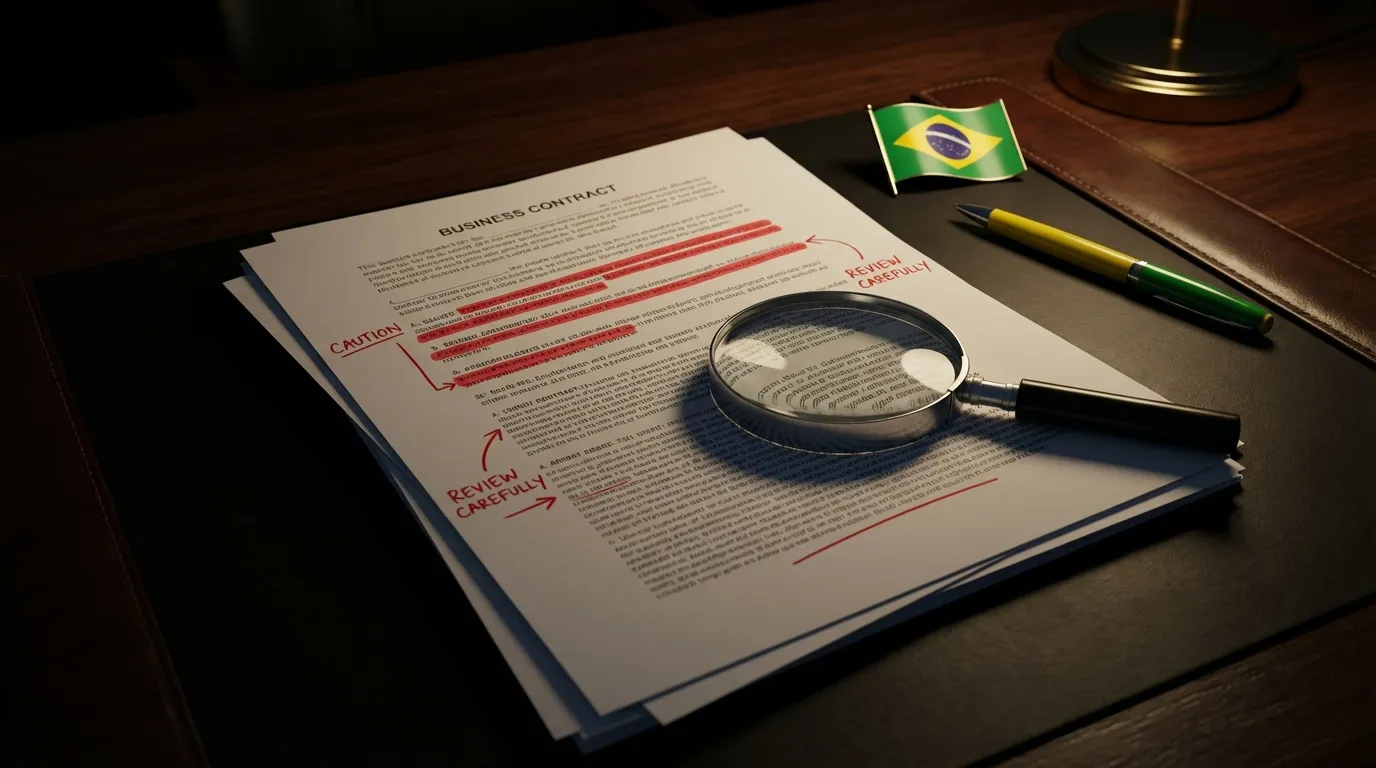
5 Red Flags in Brazilian Supplier Contracts
Common contractual pitfalls to avoid when purchasing frozen meat from Brazil.

Table of Contents
Learning from Experience
Over 15 years of purchasing frozen meat from Brazil, we’ve seen contracts that cost importers hundreds of thousands of dollars in unexpected losses. This guide shares the most dangerous clauses to watch for.
Red Flag #1: Vague Quality Specifications
The Problem: Contracts specifying “Grade A” or “Export Quality” without detailed specifications leave room for interpretation.
What to Look For:
❌ "Product: Chicken Breast, Grade A"
✓ "Product: Boneless Skinless Chicken Breast, calibration 170-220g,
    no blood spots, <2% added water, vacuum pack 15kg/carton"
Risk: Receiving lower quality product that technically meets vague specifications.
Red Flag #2: FOB Loading Terms Only
The Problem: FOB terms transfer risk to the buyer once cargo passes the ship’s rail. Some sellers exploit this to avoid responsibility for loading damage.
What to Look For:
- No pre-shipment inspection clause
- No loading supervision requirement
- No photographic documentation at loading
Solution: Insist on FOB stowed or CFR terms, and include pre-shipment inspection by SGS or Bureau Veritas.
Red Flag #3: Payment Before Loading
The Problem: Some contracts require full payment before container stuffing, leaving buyers with no leverage if quality issues arise.
Dangerous Terms:
- “100% TT before loading”
- “50% advance, 50% against packing list”
Safer Alternatives:
- 30% TT advance, 70% LC at sight
- 10% advance, 90% against copy of B/L
- Letter of Credit with inspection certificate requirement
Red Flag #4: Force Majeure Abuse
The Problem: Overly broad force majeure clauses can excuse non-performance for issues that should be manageable.
Watch Out For:
- “Market conditions” listed as force majeure
- “Currency fluctuation” as excuse for non-delivery
- No obligation to mitigate or find alternatives
Better Language:
Force majeure limited to: acts of war, government
export prohibition, natural disasters directly affecting
processing plant. Seller must provide documentary
evidence within 48 hours.
Red Flag #5: No Quality Claim or Recall Process
The Problem: Contracts without clear quality claim procedures make it nearly impossible to recover losses.
Essential Clauses:
- Maximum days to file claim (typically 14-21 days from arrival)
- Required documentation (surveyor report, photos, lab results)
- Seller’s inspection rights
- Resolution options (replacement, credit, price adjustment)
- Arbitration venue (ICC, GAFTA, or similar)
Bonus: The “Exclusive Agent” Trap
Be cautious of contracts granting exclusivity without:
- Minimum volume commitments from seller
- Performance standards
- Exit clauses for non-performance
- Clear territory definitions
Contract Checklist
Before signing any Brazilian supplier contract:
- Detailed product specifications with tolerances
- Loading terms and supervision requirements
- Payment terms with quality-based safeguards
- Reasonable force majeure definitions
- Clear quality claim process
- Arbitration or dispute resolution clause
- Governing law specified
GB Trading as Your Partner
We pre-vet all supplier contracts and provide model agreements with GCC importer protections built in.
Request our supplier contract checklist.